The Whispered Bell
A mother’s grief becomes a prayer the dead cannot ignore. But when love calls across the veil, something else may answer.
Eleanor learned the language of silence in the months after Thomas died.
It spoke through the moor when the wind dropped, through the kettle that never quite boiled, through the dent his small body had left in the cushion by the fire. The world went on with its ruthless daylight; she lived at the edges of it, where dusk lingered and the house remembered.
He had slipped from the riverbank in February, chasing the toy boat she’d made him for his birthday. By the time they found him, the current had taken his breath and left the frost to finish what the water began.
There were nights she still woke to the echo of that splash — small, ordinary, final.
In the attic, beneath old trunks and a moth-eaten quilt, she found her grandmother’s journals. They smelled of lavender and damp and something older — the sweet, metallic breath of time. The entries were mostly village weather and births, with sudden breaks into recipes, cures, warnings. Between a note about rheumatism and a receipt for plum wine, Eleanor found a page headed rites of remembrance. Tucked against the binding lay a brass bell, cool as river-stone, no bigger than an apple. A frayed card was tied to its handle with thread the colour of smoke:
For calling what should not be forgotten. Ring thrice by moonlight, when the veil is thin.
She laughed, once, because the alternative was to break apart. Still, she carried the bell downstairs and set it on the mantel. It had a dent along its lip, the sort a child might make by dropping it on stone. She pressed a finger there and felt the faintest vibration, as if the metal remembered ringing.
Night drew itself across the windows. Beyond the garden wall, the moor took on its old shape — an animal sleeping, ribs rising and falling. Eleanor lit the candles she had not used since the funeral, chalked a circle on the flagstones because the page said she must, and opened the back door so the moon could watch. She spoke his name the way you touch a bruise, gently and not enough.
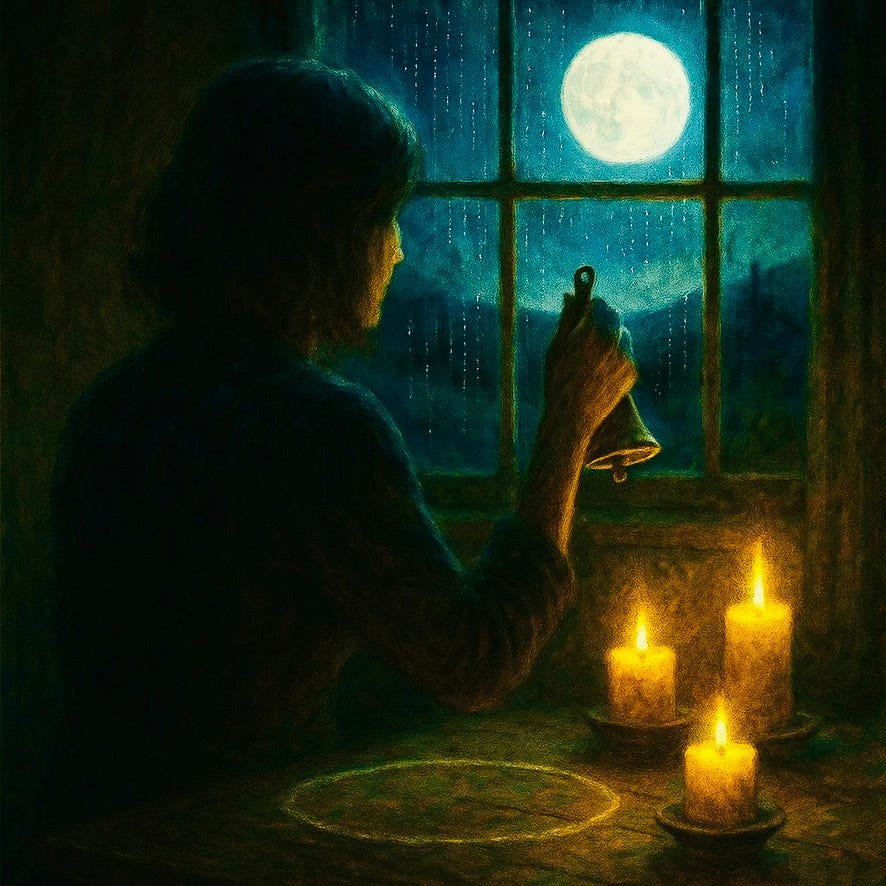
When she rang the bell, the sound was smaller than she expected. It held to the room, a shimmer that turned in place. The candle flames lowered as if listening.
“Thomas,” she whispered. “My love. If you hear me… only a word.”
Nothing. Only the moor’s breath and the thin sigh of wax. She lowered the bell, ashamed of herself and relieved. She slept on the rug beside the circle, hands folded under her chin like a child.
In the grey seam of morning, she woke to marks on the flagstone. Not footprints — those would have been absurd, impossible — but the memory of them, the faint chalky crescent of toes scuffed through the line of the circle, as though something had considered stepping in and thought better of it. Eleanor placed her hand over the marks and laughed again, the sound breaking.
The second night, the sky was scoured clean, the moon high and pitiless, turning the moor to silver bone. She told herself she only wanted proof that the first had been a trick of grief. She rang the bell once, and the air drew tight as thread.
From the stair, a weightless patter. She rose slowly. A shadow passed through the half-light on the landing, and in its passing the room smelled briefly of wet earth and ash — the scent of the churchyard path when the gate swings open. Eleanor’s hands shook. She could not make herself step forward.
“Thomas?” she said. The word was a house she had been forbidden to enter and now found unlocked.
The shadow stilled. When it spoke, the voice was both right and wrong, like a tune played true on a cracked instrument.
“I missed you, Mama.”
The chalk circle brightened of its own accord. Cold rose from it like breath. Eleanor reached toward the dark and met air so frigid it burned. The bell slipped in her numb fingers and struck the flagstone with a dull chime. She did not remember falling, only waking on the rug at dawn with grit in her cheek and the bell lying warm against her palm, as if someone had set it there.
She told herself it was enough. She told herself she had proof now, and knowing would have to do. She told herself many sensible things and believed none of them. At dusk she set the kettle to boil and never came back to pour it.
“Not a summoning,” she said to the room, to the moor, to the boy she had taught to tie his shoes and never again would. “A farewell done properly. That’s all.”
Candles. Chalk. Door open to the moon. The bell in her hand, the card’s thread wrapped round her wrist as if it were a promise.
The first chime bit the air like frost. The second seemed to strike from elsewhere, from the field and the lane and the dark hedge beyond. She held her breath and lifted the bell for the third.
“Come home,” she said. “Come back to me, Thomas.”
The silence that followed felt deliberate. Then footsteps on the stair: small, careful, counting the boards the way children do when they have been told not to run. The figure that reached the threshold was the size of a child. In the candlelight its head was bowed, as if shy. Eleanor took a step, and the figure raised its face.
The eyes were a child’s shape but not a child’s eyes. Their dark was too deep, a well without a bottom. The smile was learned rather than born, a curve fitted onto a mouth unused to it.
“You called,” it said. The voice was soft and wrong in no particular way one could name. “And I came.”
Her throat closed. She wondered if I blow out the candles, the dark will go, as if light were the thing holding it here. She could not move.
“He is quiet now,” the not-boy continued, peering into the circle as if into a pond. “He is loved. You taught him that. He does not want.” It cocked its head. “But there were others who heard. Old names. Hungry ones. We are good with hunger.”
Eleanor closed her eyes. Behind her lids, memory produced a hundred small mercies: Thomas asleep with his hand open like a starfish, the cut on his knee he insisted would never heal if looked at, the way he had once asked if the moon had bones. The bell trembled in her grip.
“Please,” she said. “I only wanted—”
“Wanting is the door,” said the not-boy. Its voice blurred, gained edges, became a chorus where one voice had been. “You rang. We answer. This is how it is.”
The brass burned her palm. Wax guttered on the nearest candle and ran like tears. In the dark the figure stepped forward and the circle brightened as if pleased, as if welcoming what understood its lines better than she did. Eleanor felt the cold find her ribs, not with tearing but with pressure, like a hand making room for itself.
She thought of the river’s pull, of how quickly the world could take what it was given. Now she was the current, and something else would drown.
When morning came, the kettle had boiled dry and the cottage carried a new smell beneath the ash: a tang like struck iron. The door to the yard stood open. On the flagged hearth, where the chalk lines were smudged and the wax had cooled into pale islands, a single footprint marked the ash. It was neither a child’s nor a man’s: the length of one, the weight of the other, the heel slightly wrong, as if it had learned walking from watching and not from practice.
Weeks salted themselves into months. The cottage emptied as all houses do when grief moves out of them, taking photos and clothes and leaving dust that holds a shape briefly when the sun goes low. In late autumn a traveller crossed the moor and, seeing shelter, pushed the door with his shoulder.
He stepped into a silence that felt expectant. On the hearth he found a little brass bell half-buried in ash, polished clean though no one had lived there for some time. A card was tied to its handle with new thread the colour of smoke.
For calling what should not be forgotten. Ring thrice by moonlight, when the veil is thin.
The traveller smiled at the quaintness of it and slipped the bell into his pocket. As he set out across the moor, the bell knocked softly against his hip in time with his stride, and there seemed to be, just behind him, the lightest echo of laughter — thin as breath, bright as a blade. He did not turn. He had the road and the day before him, and the world was generous with both.
Behind him, the cottage watched the door drift shut. Somewhere, beyond the reach of weather, a small hand held a circle of brass and tilted it to catch the light. A wanting considered itself, then considered again.
When the moon rose, the bell remembered its note.