Do Not Let Her Sleep
— A village lullaby that must never end.

I was told to listen, not to pray. Prayer lets you look away. Listening means staying until the sound changes.
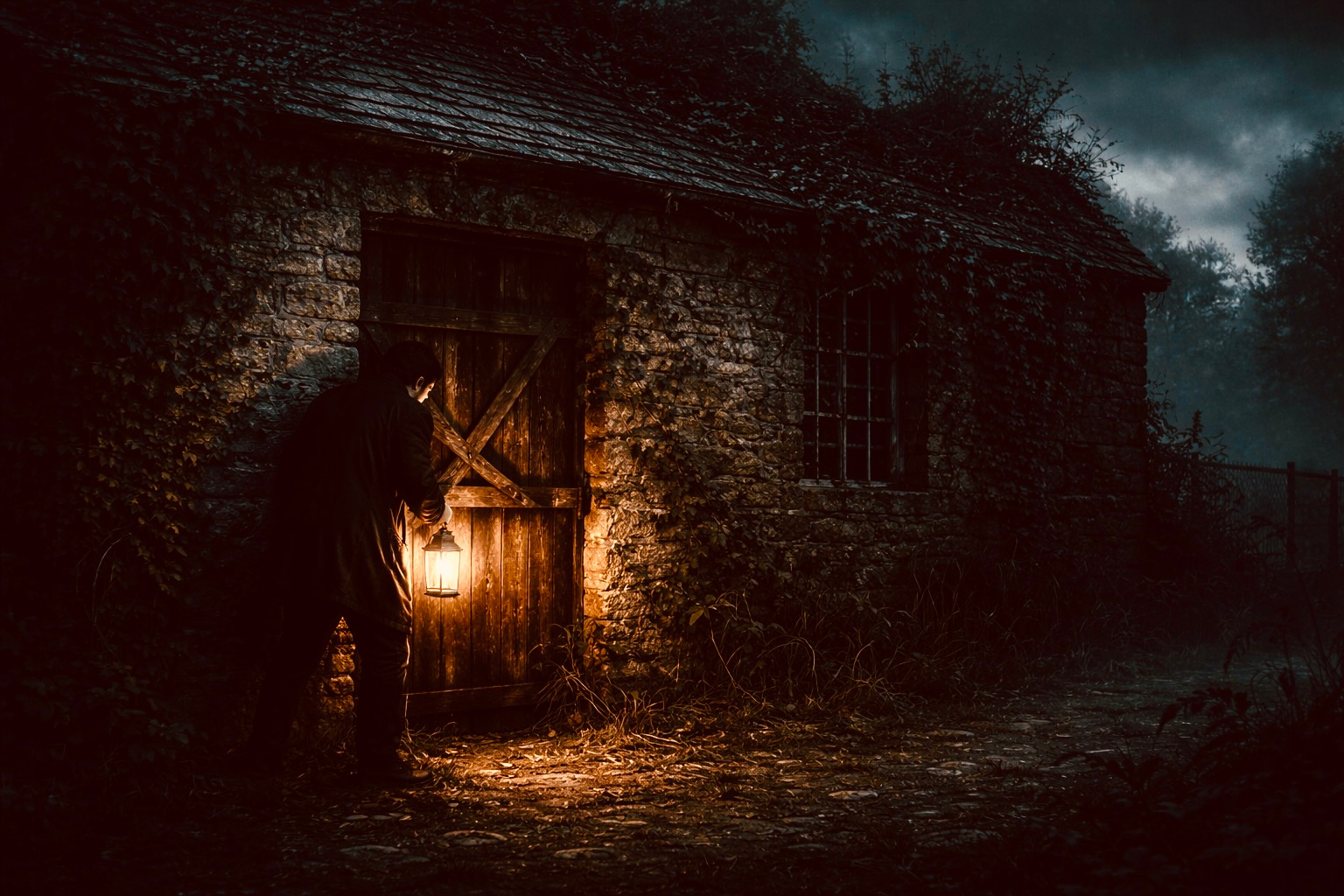
Every night at dusk I take the lantern past the church and down the track to the old dairy, where the doors have been braced shut as if from the inside. The village calls it a ruin. Ivy covers the bars on the windows. Visitors are never brought near it.
Inside, she sings. Not to us. Not to a child. She sings the way a hand presses on a wound – not because it heals, but because lifting it would be worse.
She fills most of the room. That is not metaphor. The dairy was built for cattle and barrels, not for a body like hers. Her shoulders are jammed into the beams. Her knees are drawn up, joints wrong, skin split and healed where bone has tried to move and found no space.
Her face keeps trying to be a face. Her jaw has been wired so many times the metal has grown into her. Scar tissue pulls her mouth into a raw, permanent grin. When she sings, fresh blood beads at the corners and trembles with the vibration.
The lullaby itself is wrong. Three notes, rising and falling in a pattern that ought to comfort but does not. It never varies. It never stops. I once tried to hum it on the walk home. My tongue went numb. My teeth ached. I tasted iron for hours. I do not hum now.
I stand by the doorway where the air is thinnest and watch her chest. When the song holds, her ribs rise and fall in time with the notes. When it falters, something shifts beneath her skin. That is the part we are keeping in.
Sometimes I see mouths opening along the underside of her arms – small slits parting softly, as if tasting air. I hear a second sound beneath her voice then. Not echo. Harmony.
That is why we feed her hot broth through a funnel. Why we bring clean cloth for the bleeding mouth. Why we scrub the floor when her skin sheds. Not out of mercy. Because if she weakens, we will pay.
The rules are simple. No one speaks her name. No one calls her “mother” within earshot. I was told never to call her mother again. No one enters the dairy alone. And if the song falters longer than a breath, the listener rings the bell twice so the men come with ropes and hooks, and we do what we can to make her sing again.
I have rung it once in my life.
Tonight the song is wrong from the start. The first note is late. The second is thin. The third cracks, sharp as ice underfoot. Her head lolls. Blood slicks her chin. The lantern catches on the wire in her jaw and makes it look like a smile.
“Come on,” I whisper, hating myself for it.
Her eyes move. Something behind them turns toward me. The song stutters.
A cough claws up her throat. It is not her cough. It has too much depth, as if it comes from a space larger than her lungs. Her mouth opens wider than the wire should allow. Scar tissue tears. The sound that follows is a note that does not belong to any human scale.
For half a second, something under her skin sings back. Then she stops. Silence leans in.
She exhales. Her shoulders sag. Her wired mouth slackens. I realise with a cold shock that I have never seen her at rest. She has never rested.
Her eyelids close. Sleep, in any other creature, is mercy. In her it is a door.
Her abdomen moves. Not breath. Pressure. A seam opens along the old scar down her torso. The flesh parts with the sound of wet cloth tearing. Something pushes through. Not a hand – a cluster of fused fingers, slick and pale, nails too long and too clean. Another mouth opens in her side, wide and tooth-lined, drawing in air.
It sings. The lullaby, but corrected. The same notes landed perfectly. The walls resonate. The lantern flame leans toward the sound.
I run. The song follows me out into the night. It slides under doors and into windows and down chimneys. It doesn’t need to be loud. It only needs to be heard.
Lights go out as I pass. A dog’s bark cuts off mid-yelp. A baby’s cry snaps closed like a broken string. The village is settling. Not because it is tired. Because it is being made ready.
I reach the church and ring the bell twice, hard enough to split my palm. Men spill from doorways, half-dressed, faces white. They look at me with the question none of us will say: Can you make her sing again?
I open my mouth. For a moment, I think I can. I think if I tear my throat open on the notes, perhaps I can hold the door a little longer. But the lullaby is already in me. It has been waiting there for years, stored like dry kindling.
The song from the dairy grows closer.
I try to sing. My voice fails on the first note. My chest locks. The bell tower tilts. Hands grab my arms, distant as gloves.
Sleep rolls through the village in a slow wave. Bodies slump in doorways. Lanterns are set down and forgotten. A horse lowers its head and simply stops.
The lullaby reaches the churchyard. It finds us. Somewhere, something sings my notes better than I ever could. My eyes close. The last thing I see is the church door standing open, as if no one thought to shut it.
For the first time, the woman in the dairy rests. For the first time, the village sleeps without her. And for the first time, we will learn what wakes without her.
Author Note:
Do Not Let Her Sleep treats the lullaby not as comfort, but as containment. The song endures not to soothe, but to hold something in place. Its repetition becomes a form of restraint — sustained less by hope than by habit.
I wanted the story to inhabit the space where folk ritual hardens into necessity, and where survival depends on continuing something that should perhaps have ended long ago. The horror lies not in the waking, but in what must be endured to prevent it.
For more about me visit my website: https://mariuscreed.co.uk